

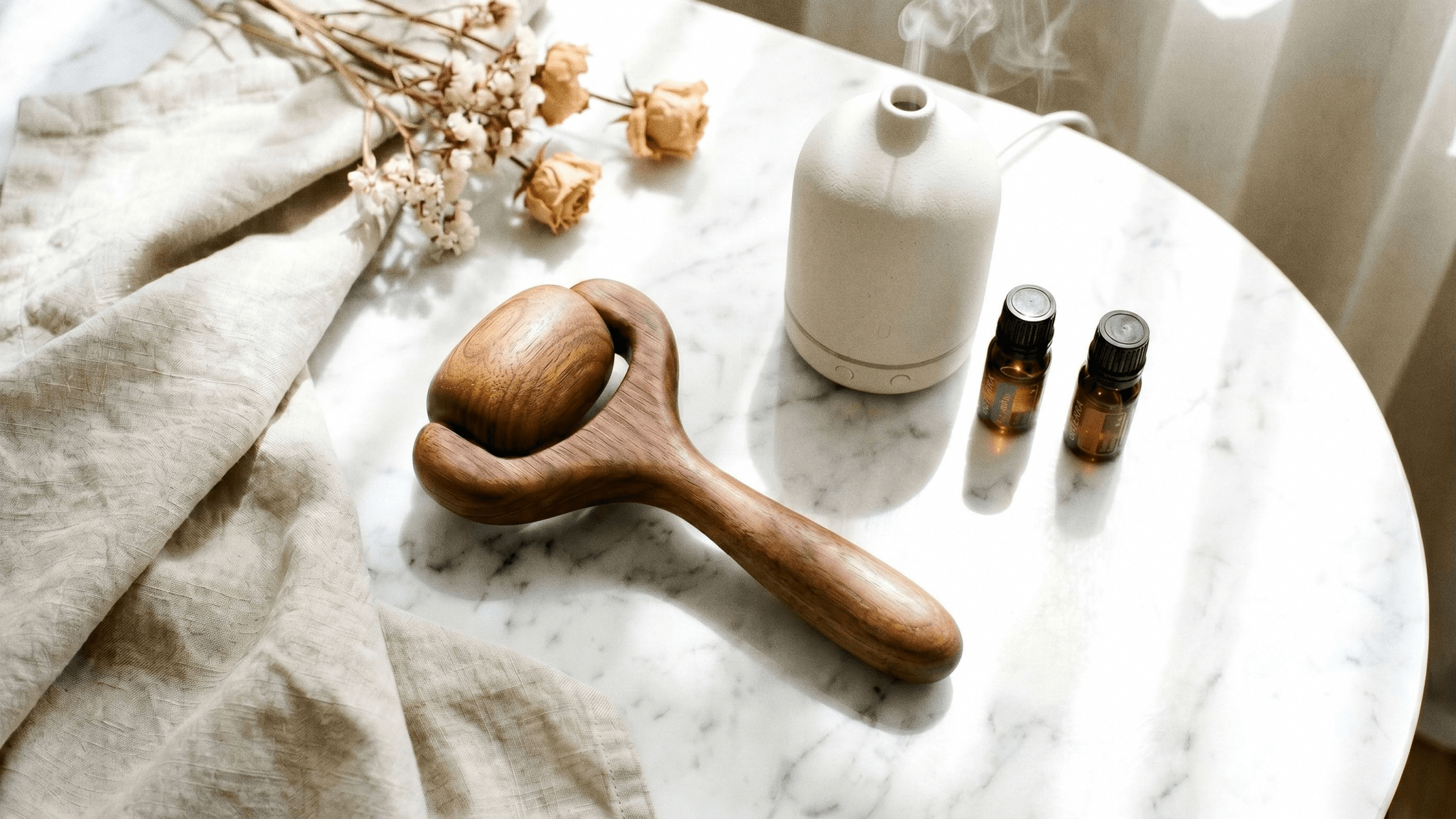
Tactile Amnesia: The Day My Body Forgot How to Feel
3:17 AM. Darkness. Silence. The world’s most ergonomic mattress cradled my body in a perfect, scientific embrace. In theory, I should have been submerged in the blissful void of sleep, a stone settled deep in a still river.
But my body was staging a mutiny.
I was acutely aware of my shoulders—they were not resting on the mattress but hovering a quarter-inch above it, perpetually hunched toward my ears like two frightened birds frozen mid-takeoff. My jaw was locked, a dull, cranial ache throbbing from my molars. My lower back maintained a precise, stubborn arch, braced to spring against a threat that never came. I issued silent, desperate commands to the unresponsive territory of myself: Relax. Let go. Release.
Nothing.
This wasn’t pain. Pain is a sharp, localized signal. This was a more total, systemic failure. My muscles, my fascia, even my skin, had lapsed into a collective, stubborn silence. They had forgotten the algorithm for “soft,” uninstalled the program for “yield.” A hug registered as a gentle impact, a hot shower as a task performed at the correct temperature. My body, the one home I was promised for life, had become a locked room, and I had lost the key.
I call this condition Tactile Amnesia. It is not an illness, but a slow, civilizational atrophy. In the endless bombardment of pings, the perpetual deferment of presence, and the long hours spent folded into a chair before a screen, our nervous systems mistake a low-grade, diffuse “fight-or-flight” state for the new normal. The body learns to brace, to guard, to prepare. It utterly forgets how to surrender, to relinquish weight, to receive a touch that asks for nothing in return. We live inside a body that has forgotten how to be lived in.
The Museum of Held Tensions: An Inventory of the Unfelt
My awakening began not with a revelation, but with an inventory. I started noticing the museum of tensions I curated daily. My upper trapezius weren’t just “tight”; they were permanent, rock-like escarpments, lifting my shoulders toward my earlobes in a perpetual shrug against gravity. The base of my skull, where the suboccipital muscles dwell, felt like a tangled knot of ancient wires, pulling my gaze downward even when I looked up. My hands, even at rest, maintained a slight curl, ready to grasp a smartphone that wasn’t there.
This was a life lived in the subjunctive mood. My pectoralis muscles were shortened, pulling my shoulders forward into a continuous, protective hunch—as ifwarding off a blow. My diaphragm, the primary muscle of breath, moved in shallow, apologetic flutters—as ifdeep breaths were a reckless expenditure of resources. I wasn’t in pain; I was in a state of perpetual readiness. I was braced for an impact that never arrived, and the cost of that eternal vigilance was the loss of simple presence. To touch this body was to touch a well-crafted suit of armor. The embrace of a loved one landed on the polished plate, a distant, muffled kindness. I was losing the ability to feelthe feeling.
The Interpreter’s Hands: A Re-Education Through Touch
My first real clue came on a massage table, under the hands of a therapist named Leo. I arrived with the modern plea: “My neck and shoulders are a mess.” He began not with his hands, but with a quiet observation. “Your breath,” he said, “it’s all in your chest. It’s afraid to go down.” Then his hands landed, warm and deliberate, on my upper back.
What happened next wasn’t a massage; it was a translation. His palms performed a slow, assessment glide (effleurage). “Your superficial fascia,” he said, his voice calm, “it’s not tissue. It’s a carapace. It’s all one hardened sheet.” The diagnosis was devastating: my individual muscles weren’t just tight; the very fabric that connected and communicated between them had solidified.
His work was a meticulous, wordless re-education. He found the edge of that hardened sheet near my right scapula. Applying the sustained, patient pressure of myofascial release, he leaned into the barrier. For a long moment, nothing. My body, a stubborn student, resisted. Then, a sudden, profound melting sensation—a fascial release—as if a thousand tiny, frozen threads all sighed and let go at once. Heat flooded the area. It wasn’t a relief I’d actively felt before; it was the memory of a sensation returning. “There,” he murmured. “It’s remembering it can be long.”
Next, he isolated a trigger point in my levator scapulae—a specific, angry knot of neurological shouting. Using ischemic compression, he applied precise, unwavering pressure directly to its epicenter. The pain was bright, acute—a scream of protest from a muscle that had been on constant sentry duty for years. “Breathe into it,” he instructed. As I exhaled, he held. On the third breath, the bright knot dissolved, unraveling into a deep, aching warmth that then radiated outward, diffusing into a spacious, liquid ease. A tear escaped the corner of my eye—a classic somato-emotional release. The knot wasn’t just a physical contraction; it was the stored tension of a thousand unresolved stresses, finally being acknowledged and released.
The Daily Practice of Remembering: Rewiring the Sensory Map
That session was a crack of light, but the door was still heavy. I realized I couldn’t outsource my way back to feeling. I needed a daily practice to retrain my nervous system, to rebuild the atrophied pathways between touch and sensation.
I started with the simplest, most radical act: a body scan meditation. Lying in that same bed, I would journey from crown to heel, not to fix, but to bear witness. Scalp: tight. Forehead: furrowed. Jaw: clenched. Shoulders: elevated. Diaphragm: shallow and held.I was mapping the museum of my own tension, learning its exhibits without judgment.
I introduced self-myofascial release with tools. Using a lacrosse ball against a wall, I’d find the trigger point in my infraspinatus, a deep rotator cuff muscle. I’d lean into the exquisite discomfort, breathe, and wait for that subtle, yielding release that signaled the muscle was letting go of its chronic hold. On a foam roller, I’d practice thoracic extensions, gently arching backward over the cylinder to coax mobility into the vertebrae of my upper back, opposing the perpetual slump.
Most transformative, however, were the sensate focus exercises. I’d sit with a curated bowl of objects: a cold, smooth river stone, a bundle of raw sheep’s wool, a velvet pouch filled with flax seeds. For three minutes, eyes closed, I would explore one object. The goal was not to identify (“stone”), but to describe sensation to myself: Cool. Dense. Smooth, with microscopic pocks. Heavy for its size. Growing warmer in my palm.I was teaching my sensory receptors to fire without the interpretive rush of my prefrontal cortex, rebuilding the raw, unfiltered connection between touch and perception.
A Protocol for Recollection: The 5-Minute Sensory Reboot
-
Ground (60 seconds): Stand barefoot. Feel the texture of the floor—the grain of wood, the pile of carpet. Sense its temperature. On an exhale, imagine your weight sinking, melting through your feet, pronating your arches slightly to increase surface contact. This is your foundation.
-
Breathe (60 seconds): Place hands on your lower ribs. Inhale slowly, feeling your ribs expand sideways into your hands like an accordion. This engages the diaphragm fully, sending a visceral “all-clear” signal to your parasympathetic nervous system.
-
Touch (120 seconds): Choose two objects with contrasting textures. Spend 60 seconds with each. With eyes closed, explore. Is it warm or cool? Rough or smooth? Damp or dry? Does the sensation change? Your job is not to think, but to feel.
-
Receive (60 seconds): Give yourself a firm, full-body hug, applying deep, calming proprioceptive input. Cross your arms and squeeze. Focus on the space between your shoulder blades—your mid-trapezius and rhomboids. On an exhale, consciously visualize those muscles softening, spreading, and descending down your back.
Recovery from Tactile Amnesia is not a return to a child’s naive softness. It is the hard-won cultivation of a new kind of resilience: the tensile strength of a supple willow, not the brittle rigidity of dry oak. It is the daily choice to exchange the armor for a living membrane—one that can protect without isolating, that can feel the world’s abrasions without becoming calloused to its wonders. The forgotten softness is not a weakness, but a profound capacity. It is the ability to be impacted, to be changed, to truly feelthe fragile, beautiful fact of being here, in a body, one breath, one touch, one remembered sensation at a time. The door is no longer locked. I am learning, slowly, to turn the handle from the inside.
Written by NAIPO CARE



Leave a comment
This site is protected by hCaptcha and the hCaptcha Privacy Policy and Terms of Service apply.