


The Ultimate Self-Massage Challenge: Body Parts Your Hands Can't Reach
We've all been there. It's 10 PM, stress has sculpted your shoulders into marble statues of tension, and all you want is some relief. Your fingers instinctively reach for that knot of pure anguish between your shoulder blades—only to discover your hands have conspired against you. They can reach doorknobs, keyboard keys, and even that pesky itch in the middle of your back, but somehow they've failed evolution when it comes to giving you the massage you desperately need. Welcome to the ultimate design flaw in the human body: the places you can't quite reach for self-massage.
This isn't just about inconvenience—it's about the cruel irony that the areas that need attention most seem to be strategically placed just beyond your fingertips' grasp. That spot between your shoulder blades? Perfectly positioned to remain eternally out of reach. The middle of your back? A no-man's-land of tension. These are what I call the "self-massage blind spots"—and they're the reason tennis balls, foam rollers, and creative use of door frames were invented.
As it turns out, our bodies are both the problem and the solution in this frustrating equation. The very flexibility that allows us to scratch most itches somehow fails us when we need to knead out the stubborn knots that life deposits in our muscles. But why? And what can we do about these anatomical "bug reports" that evolution has yet to patch?
The Unreachables: Mapping Your Body's No-Fly Zones
The Shoulder Blade Bermuda Triangle
Between your shoulder blades lies what might be the most frustrating self-massage blind spot in the human body. This area—roughly the size of a credit card but infinitely more annoying—someways manages to evade even your most determined fingers. When you try to reach it, your arm contorts into what yoga instructors might call an "advanced pose," your face scrunches up in concentration, and your fingers… barely brush the surface of the problem.
The scientific reason for this limitation is both simple and insulting: biomechanics. Your shoulder joint, while incredibly versatile, has a limited range of motion when it comes to reaching behind you. The rotation required to apply meaningful pressure to your own upper back is physically impossible for most people. It's not that you're not flexible enough—it's that human anatomy wasn't designed with self-shoulder-massage in mind.
The Spinal Frontier
Running down the center of your back is another no-man's-land of tension. While you can reach the muscles on either side of your spine, the vertebrae themselves remain largely inaccessible to your own hands. This is actually a good thing from a safety perspective—direct pressure on the spine should be approached with caution—but it leaves a central channel of potential discomfort that you can't quite address yourself.
The Middle Back Mysteries
Below the shoulder blades but above the lower back lies a territory that might as well be on another continent for all your fingers can do to reach it. This area often becomes a repository for stress during long days of sitting, yet remains stubbornly out of reach. The physics is straightforward: your arms simply aren't long enough to comfortably curve around your torso and apply meaningful pressure to this region.
Why Evolution Failed the Self-Massage Test
Our bodies are marvels of evolutionary engineering, fine-tuned over millions of years for survival and reproduction. But somewhere along the way, the product managers for Homo sapiens apparently decided that reaching every part of our own backs was a "nice-to-have" feature rather than a core requirement.
The human body is essentially a collection of evolutionary compromises. We stand upright, which is great for seeing predators (and later, for reaching the top shelf), but terrible for our backs. Our shoulders have an incredible range of motion—forward. The same adaptations that allowed our ancestors to throw spears and climb trees left us with a design that makes self-back-rubs nearly impossible.
Perhaps the most frustrating realization is that our bodies seem perfectly designed for giving massages to others, but terribly designed for giving them to ourselves. Your hands are strong enough to knead dough, your fingers sensitive enough to detect subtle textures, and your arms powerful enough to apply sustained pressure—just not on your own body. It's as if evolution assumed we'd always have a tribe member available for reciprocal scratching duties.
This design "bug" becomes particularly ironic when you consider that many of the muscles hardest to reach are precisely the ones that work overtime in modern life. Your upper back wasn't designed for hunching over keyboards, yet that's exactly what we demand of it for hours each day. The result? A perfect storm of tension in the least accessible areas.
Creative Workarounds: The MacGyver Guide to Self-Massage
The Humble Tennis Ball: Your New Best Friend
When your own hands betray you, it's time to enlist tools. The tennis ball might be the greatest innovation in self-massage since fingers. By placing a ball between your back and a wall (or the floor), you can leverage your body weight to apply pressure to those hard-to-reach spots. The beauty of this method is its simplicity: you're essentially using gravity and leverage to do what your arms cannot.
The technique is straightforward: position the ball on a wall, lean against it, and slowly roll until you find a tender spot. Then pause, breathe, and allow the pressure to work its magic. For the middle back, lying on the floor with the ball positioned beneath you can be even more effective. It's not quite as satisfying as being able to reach these spots with your own hands, but it's a close second.
Door Frames and Corner Walls: Architectural Assistance
Sometimes the best massage tools aren't tools at all—they're architectural features. A door frame or room corner can become an impromptu massage station. By positioning yourself between two walls and using your body weight to press against them, you can create a squeezing effect on your upper back and shoulders that fingers alone could never achieve.
The Foam Roller: For the Serial Self-Massager
For those serious about overcoming their anatomical limitations, the foam roller is the upgrade path. These cylindrical tools allow you to address large areas of your back simultaneously, providing a broader, if less targeted, approach to self-massage. While they won't replace skilled hands, they can significantly reduce the tension buildup in areas your fingers can't reach.
The Art of Leverage and Positioning
Sometimes the solution isn't a tool but a technique. By strategically positioning your body, you can sometimes create enough leverage to reach previously inaccessible areas. For instance, using the opposite arm to push an elbow toward the back can create a sort of "leveraged pressure" that gets closer to those stubborn spots. It's not elegant, but in a pinch, it can provide relief.
The Psychological Dimension: Coming to Terms with Your Limitations
There's something fundamentally human about the frustration of not being able to reach your own back. It's a daily reminder that we are limited creatures, bound by our physical form. In a world that increasingly promises total control and customization, the inability to massage our own backs stands as a stubborn reminder of our embodied constraints.
But perhaps there's wisdom in this design "flaw." The fact that we can't easily reach our own backs might be evolution's way of encouraging social connection. Throughout history, grooming and mutual care have been bonding activities in human societies. The very limitation that frustrates us today might have been what encouraged our ancestors to form stronger social bonds.
There's also a lesson in acceptance. However flexible you become, however many tools you acquire, there will likely always be some part of your back that remains just out of reach. Learning to live with this limitation—while finding creative ways to work around it—is its own form of wisdom.
When to Call in Reinforcements: The Role of Professional Help
For all our ingenuity in developing self-massage workarounds, sometimes the best solution is to acknowledge the limitations and seek help. Professional massage therapists exist for a reason: they can reach places we can't, with knowledge we don't possess. Regular professional massage can address the accumulated tension in those hard-to-reach areas, complementing your self-care routine.
Interestingly, the areas we can't reach ourselves are often the same areas that benefit most from professional attention. This isn't a coincidence—the muscles between your shoulder blades and along your spine are postural muscles that work constantly. They're prone to tension precisely because they're always active. Professional massage can give these overworked muscles the attention they deserve.
Embracing the Journey: The Future of Self-Massage
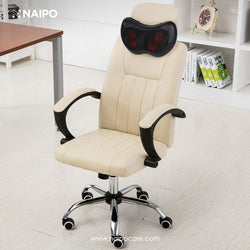
As technology advances, we're seeing new solutions to age-old limitations. Massage chairs become increasingly sophisticated, targeting specific points with precision that human hands might struggle to match. Wearable massage devices are becoming more common, offering hope that someday we might have better tools for addressing our anatomical blind spots.
But perhaps the real innovation isn't technological but philosophical. Maybe the solution isn't to find better ways to reach our own backs, but to rethink our relationship with self-sufficiency. In a hyper-individualistic world, the simple act of asking for help with a sore back can be a radical acknowledgment of our interdependence.
In the end, our unreachable spots remind us that we're social creatures, designed for connection. The very limitation that frustrates us might actually be pointing toward a deeper truth: that some needs are best met in community with others. So the next time you find yourself frustrated by a knot you can't quite reach, remember—it's not a design flaw, it's an invitation to connect.
The ultimate self-massage challenge isn't really about conquering every inch of your own body—it's about learning to work with your limitations, both anatomical and otherwise. And in that challenge, we might just discover something more valuable than a perfectly massaged back: a little more grace in accepting what we cannot change, and creativity in changing what we can.
Ecrit par NAIPO CARE


Laisser un commentaire
Ce site est protégé par hCaptcha, et la Politique de confidentialité et les Conditions de service de hCaptcha s’appliquent.